
3.2.1What is a derivative?
Definition of a Derivative
How does a graphing calculator determine the slope of a tangent line? Or, how did mathematicians determine slopes before technology was available? In this lesson, we will look at slopes of secant lines and tangent lines by examining three different methods to determine the exact slope of a tangent line at its point of tangency.
To start, we will revisit the use of secant lines by studying the different slopes when
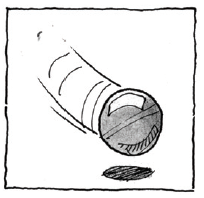
Each of the following students used a different method to estimate the velocity of the ball at
| ||||||
|
Hana estimated
Anah estimated the slope as
Hanah estimated the slope as
What are the units of the slopes found by each student? Explain why.
Compare and contrast each student’s method.
Trace the graph at right of
on your paper and sketch the secant lines that Hana, Anah, and Hanah used to approximate the slope at . Is Hanah’s slope the average of Hana and Anah’s? Does this mean that Hanah’s method gives the best approximation?
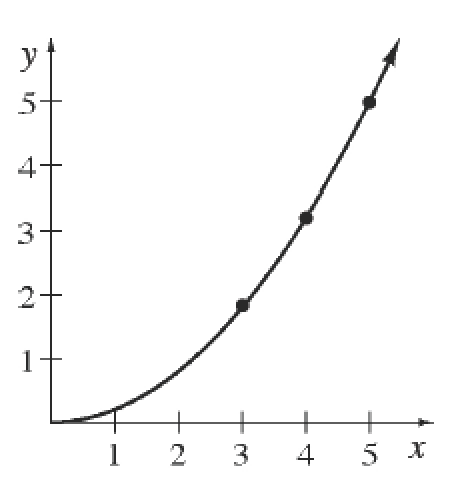
Explore this using the 3-35d Student eTool. Click in the lower right corner of the graph to view it in full-screen mode.
To approximate the slope of the curve
If the second point is located at the point
, write and simplify an expression that represents the slope of this secant line. Whose method did Devin use from problem 3-35: Hana’s, Anah’s, or Hanah’s?
To get the exact slope of the tangent line at
, what should be done with ? Write an expression that represents the true slope at . Use your expression from part (c) to determine the slope of the curve at
. Does it matter if
is positive? Why or why not?

Hanah wants to use her method to determine the slope
Write and simplify an expression to represent the slope of Hanah’s secant line and then calculate the slope of the tangent line.
Use Hanah’s method on
to determine the slope of the tangent line when . Write a slope function that represents the slope of
for all values of .
.png)
Use each method from problem 3-35 to write general algebraic expressions which approximate the slope of a function

The Derivative
The slope of a line tangent to at any point
If the slope (or instantaneous rate of change) at a particular
.png)
The Math Notes box in this lesson features the definition of the derivative using Hana’s method. Write the definition of the derivative using Anah’s method and the definition of the derivative at a point
Use the definition of the derivative to write a slope function, for
Lulu used the limit below to write the derivative of a function
What is the equation of
? What is the equation of
?

Rewrite each of the following expressions in the form of
Write and evaluate a Riemann sum to estimate the area under the curve for
Given the function
At right is the graph of a function
.png)
Calculate the area under the curve for
After completing the Ramp Lab in Chapter 2, Marquita decided to ride her bicycle down a nearby hill to gain more data on rolling objects. The data she collected is shown in the table below. Homework Help ✎
Time (sec) | ||||||
Distance (m) |
Can Marquita use this table to determine her exact velocity at
Explain. Approximate Marquita’s velocity at
using Hana’s method. Marquita’s teacher observed that her data fits the function
. Assuming that her teacher is correct, compute Marquita’s exact velocities at and .
.png)
Write a slope statement to describe the graph below. Homework Help ✎
.png)
Write the equation of a tangent line that is a linear approximation to the function
WHAT A DAY!
Below is a graph of the distance David traveled away from his home on a trip to the mountains. Place the events listed at right in the proper order based on details from the graph.
Trace the graph below and identify the parts that correspond to each event during David’s trip.
Then answer parts (a) through (d) below. Homework Help ✎
EVENTS
|
.png)
What are the units for the slope of the curve?
What is significant about the slope of the curve when David is stopped?
How does the slope of the curve tell you when David is speeding?
Interpret the graph where the slope is negative. What is David doing then?
Evaluate each limit. If the limit does not exist due to a vertical asymptote, then add an approach statement stating if
(Careful!)


